Inside Leadership @ Domino Data Lab: Tom Gleason, CFO

About Tom Gleason
Tom Gleason joined Domino Data Lab as Chief Financial Officer in September 2021, bringing two decades of SaaS finance leadership experience.
His career spans Ernst & Young's Audit and Transaction Advisory Services groups, a nine-year tenure at Tableau Software where he rose from Revenue Manager to VP of Finance, and VP of Finance & Strategy at Avalara. Gleason holds an M.S. in Accountancy from the University of Notre Dame's Mendoza College of Business and dual degrees in Accounting and Finance from Gonzaga University.
His accounting-to-CFO progression represents a path that shaped his bottom-up approach to financial leadership.
Ask most people what a CFO does all day, and they'll paint the same picture: someone hunched over spreadsheets, parsing financial models, optimizing for quarterly earnings. Tom Gleason, four years into his tenure as CFO at Domino Data Lab, has a confession that contradicts everything you’d expect.
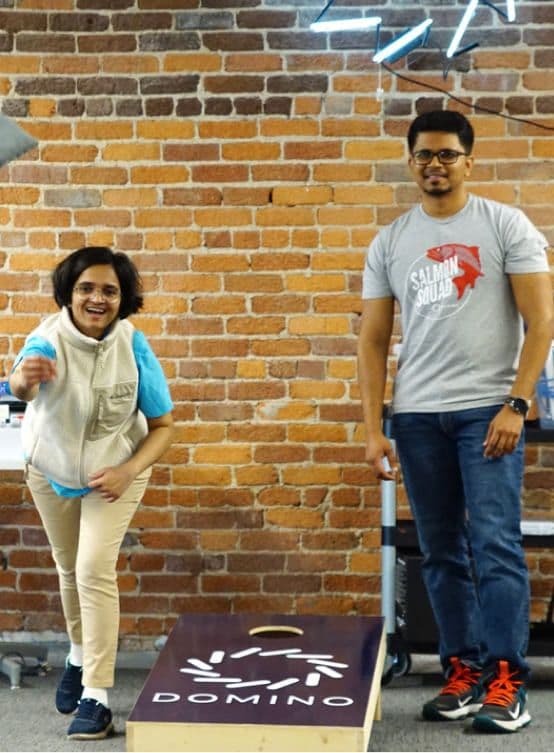
"Contrary to popular belief, I probably spend increasingly less time in spreadsheets the more senior I get," Gleason says, sitting with Domino’s People Team during a recent team offsite. "So much of this job ends up being about people and about judgment, trying to make decisions using the best information available, which usually is not complete information, but still needing to make a call."
It's a shock, he admits, even to himself. But it's also the key to understanding how Domino approaches financial leadership. Here, the finance function exists to accelerate great work, not gatekeep it.
Lessons in persistence
Early in his career at a major data analytics company, Gleason was doing solid work in accounting but wanted to pivot into corporate finance. When a director role opened in FP&A, he made his case, explained why he'd be the right fit. The timing wasn't right. The role required someone with more established experience, and while they respected his work, they needed to go another direction.
"I could have easily given up on that pursuit," Gleason reflects. "I could have gotten frustrated, moved on to another opportunity." Instead, he stayed focused, took on additional projects outside his core role, and demonstrated capabilities beyond his current position. Eventually, an opportunity emerged, and that pivot into corporate finance ultimately rounded out the skill set that would shape his path to CFO.
"’No’ now doesn't mean ‘no’ forever," Gleason says. It's a lesson that shapes how he thinks about everything, from personal career growth to company strategy. The best outcomes often require patience, perseverance, and the belief that consistent execution gets recognized even when results aren't immediate.
That philosophy shows up in how Domino approaches growth. When Gleason joined in September 2021, venture capital was plentiful and growth-at-all-costs was gospel. "It was a very different time for technology companies," he recalls. "Money was free flowing. Many companies were in grow, grow, grow mode." But Domino has consistently chosen a different path; focused on building durable, sustainable operations rather than chasing the next funding round.
From gatekeeper to accelerator
In most organizations, finance is the Department of ‘No.’ Budget requests get declined. Investment proposals get shot down. The CFO's job is to protect the balance sheet. Gleason has spent his tenure at Domino trying to flip that script.
"The thing that I try to be careful about is not to just be the person that always has to say ‘no’ to everything," he explains. "It's really trying to find a way to get to ‘yes’… to fund not any investment, but the right investment."
That means understanding what various leaders are trying to execute against and figuring out how to enable their best work. Sometimes that means approving additional investment. Sometimes it means brainstorming about reallocation or phasing spending over time.
"I really look at my job as trying to enable other leaders to do their best work," he says, "and not just be the Department of No." The result is a finance organization that makes decisions based on long-term sustainability rather than short-term trends.
Small teams, big impact
Walk into most scaling tech companies and you'll find a familiar pattern: as headcount grows, individual impact shrinks. Junior employees can get lost in layers of hierarchy. Good ideas falter in approval chains. The loudest voices dominate conversations.
Domino has avoided this path. The company has stayed lean, not because they had to, but because they believe smaller creates strategic advantages that larger organizations just can't replicate. "It's not a scarcity mindset," Gleason emphasizes when describing the company's approach. "It's more about, ‘how can we do our jobs better every day? How can we work smarter as a team?’"

The difference shows up in how team members (of all levels) can influence company direction. Michelle, on the accounting team, noticed opportunities to improve process efficiency and took the initiative. She reduced the number of days it takes to close the books, changed systems to make vendor payments and expense reporting more seamless.
"That wasn't me saying, 'Hey, I think we need to make [closing] more efficient,'" Gleason points out. "This was her noticing that there was an opportunity, coming to me with her proposal, and then leading the charge."
A company the size and stage of Domino offers a lot of ability for people to come in and have impact, Gleason explains. "That can be our most junior people all the way up to senior levels of leadership. The ability to come in and take ownership, to have your ideas listened to, and be able to go try to execute against those, that's really alluring."
The accessibility goes beyond finance. When asked about the company's culture of being able to "reach out to Nick [our CEO] whenever needed," Gleason sees it as fundamental to how ownership develops.
"If they feel like they have direct lines of communication into the most senior levels of leadership, I think it gives them a different sense of perspective and ownership of the job and being fiduciaries of the company, versus 'I'm just a cog six levels down.”
He's deliberate about modeling this himself.
"I want everyone in my organization to feel like, if they really need to, they can come directly to me with a question, comment, or concern.”
The human variable
There's a moment in every CFO's career when they realize the job isn't what they thought it would be. For Gleason, that realization came gradually, then all at once. "Maybe the first thing you think of when you think about what a finance person does is an Excel spreadsheet," he says. "What's surprised me is just how much of this job is really about people and relationships and communication, not just the numbers."
Most of his day revolves around helping people work more effectively, fixing lines of communication, helping teams make decisions. "It's a significant shock," he admits.
"So much of my day is about resolving people matters and challenges and communication, making sure people understand certain trends or dynamics in the business. The numbers are a part of it, but not the whole job."
This people-first approach didn't come from business school. It came from watching his mother, a teacher, approach her work with what he now recognizes as servant leadership. "Her passion and energy she put into serving her students; I think seeing how she approached teaching taught me a lot about leadership," Gleason reflects. "Trying to recognize we're all just people trying to do the best we can."
That humanity shows up in unexpected ways. Gleason describes himself as naturally conflict-averse, a people pleaser by nature. "But as a finance leader, as a CFO, that's not really what the job requires much of the time," he acknowledges. For Gleason, learning when to be more forceful and put his foot down has been an ongoing evolution. "You don't want to be at either end of the spectrum. Having a contrary opinion is fine, but to be successful and effective, you have to be willing to put your foot down and know when to draw hard lines," he said.

Four years in, looking forward
When asked what he'd tell himself on day one at Domino, Gleason's answer is simple: "You can do this. You're going to have a great group of peers and teammates across the company that are going to help work with you to drive this company forward."
Four years later, Gleason is clear about what matters: continuing to build, continuing to grow, continuing to innovate. "We need to continue to reach more customers and continue to drive innovation in the product," he says. "We can't take our eye off efficiency, but we also need to keep building."
For candidates evaluating whether to join Domino, Gleason's advice reflects the culture he's helped build:
"You should expect to find a group of teammates that are willing to help you succeed, want to get to know you, want to collaborate. You should expect leaders who care about you, who communicate clearly."
The expectation in return?
"Come in and feel confident to share your opinion. Ask questions. Get to know the business. We want the best of your experiences and your talents."
As for the broader lesson from Domino's approach, choosing sustainable discipline over growth-at-all-costs, building a culture where team members (of all levels) drive major initiatives, maintaining accessibility at every level, Gleason comes back to the same theme that's shaped his entire career.
Patience. Perseverance. The belief that ‘no’ now doesn't mean ‘no’ forever. The spreadsheets matter, of course.
But in the end, it's always been about the people behind the numbers.