Data ScienceData Science TeamsData Science Leaders
June 26, 2025 | 7 min read
Resetting the enterprise data science environment and lifecycle



Domino has always been for the data scientist. We started with a simple idea: give data scientists the freedom to explore, build, and deliver without getting blocked by infrastructure or process. That idea still drives everything we do.
With Spring 25 launch, we’re taking another step forward. This release focuses on the daily experience — removing common friction points, giving teams more flexibility, and making it easier for IT and data science to work together without tradeoffs.
The way data science work gets done has changed. Local IDEs have become AI-enabled and more customizable. Open-source communities now routinely ship high-quality, cutting-edge packages that help solve the hard problems. These changes have expanded what’s possible for model builders. But in most enterprises, the gap between tooling and infrastructure keeps growing.
Data scientists often can’t use the IDEs they prefer with the compute and data that IT provides. Package management is still a hassle. Environment updates break reproducibility. Workarounds take time and attention away from modeling.
With Spring 25 launch, Domino is helping teams avoid that overhead. Data scientists can now connect local IDEs to Domino workspaces. They get access to the same compute and data, without losing their local setup. Packages installed during a session persist. $HOME directories now persist. Workspace environments can be kept up to date without manually rebuilding every time something changes upstream.
These improvements reduce context switching and rework. Teams spend less time solving environment problems and more time building and delivering models and apps. IT also gains more control, without introducing more overhead.
Most data scientists already have a local setup dialed in. Their IDE is customized with the right extensions, themes, shortcuts, and productivity tools. Forcing them into a browser-based interface breaks flow and slows down iteration. It’s a small thing that becomes a big distraction.
With Spring 25, Domino is making the day-to-day experience better for data scientists. Data scientists can now connect a local IDE, like VS Code or Cursor, directly to a Domino workspace using SSH. Code runs on Domino’s infrastructure, but editing happens locally — where users are fastest and most comfortable.
Extensions like GitHub Copilot work out of the box. There’s no need to manage SSH keys. Security stays tight with a managed proxy and Domino’s standard authentication. Admins can turn the feature on or off globally, depending on policy.
This change improves focus and reduces context switching. It gives teams a faster path to iteration and learning. When tools align with the way people actually work, better results follow.
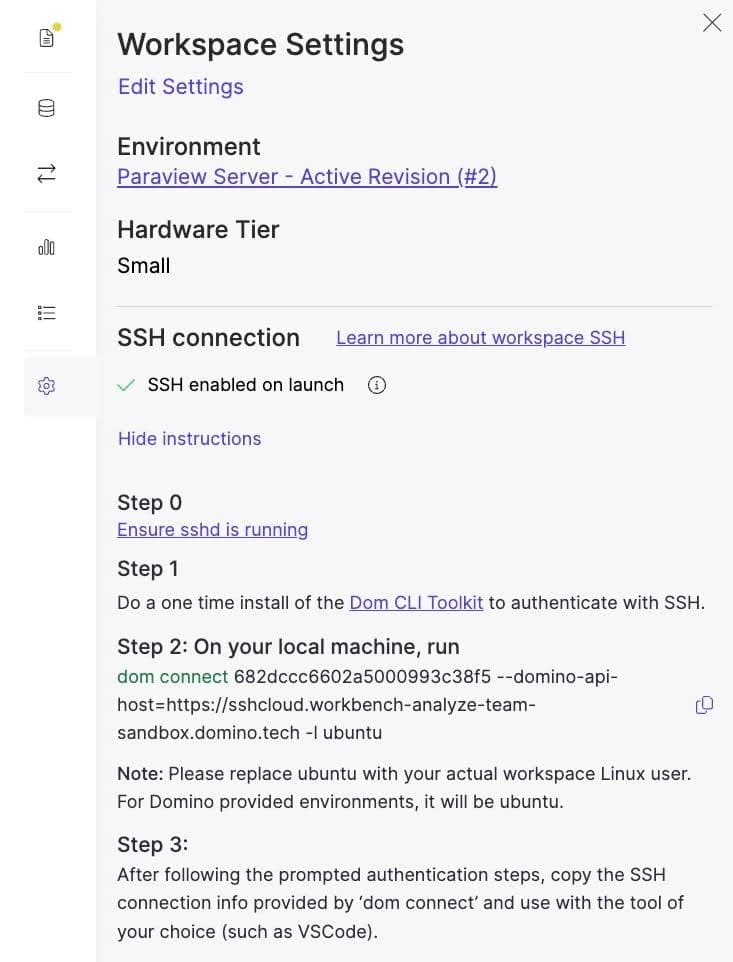
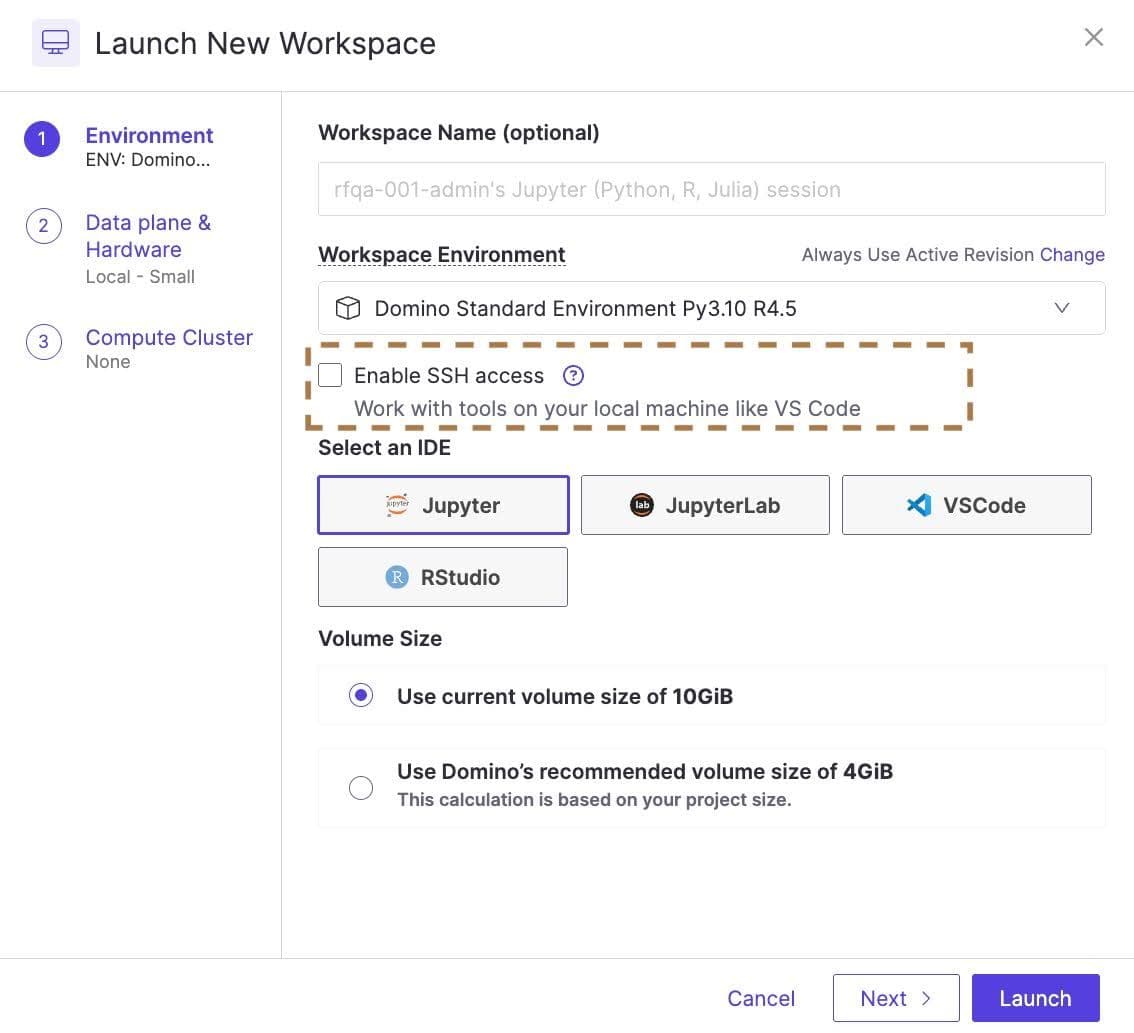
Domino is making secure, local development workflows possible for enterprise teams that were previously blocked.
This includes tools and workflows that depend on local IDEs, such as:
For your organization, this means:
Domino built Spring 25 to give data scientists a better daily experience, and give IT a cleaner, maintainable way to support it.
To operationalize data science at scale — what we call an AI factory —you need environments that are stable, reproducible, and easy to maintain. But in most teams, managing environments still involves a lot of manual cleanup and rework.
Workflows span multiple days and sessions, yet packages installed at runtime get wiped. Configs disappear. Dockerfiles need constant updates just to avoid regressions. It slows teams down and eats into modeling time.
With Spring 25, Domino is making it easier to manage that overhead and get back to the work that matters.
Now, packages installed during a session automatically persist across future sessions. So do user-specific $HOME directories. Data scientists no longer have to track what they installed and then remember to copy it into a Dockerfile or requirements.txt file. Workspace startup is faster, and the environment behaves as expected, without surprises.
Domino is also giving IT teams more control over how environments are updated and governed, without adding complexity.
These two controls work together to influence how subscription-based builds propagate. If the Active Revision is pinned, updates won’t cascade to subscribed children until the user manually changes the Active Revision. If left unpinned, the Active Revision is set to the latest build, and builds are propagated automatically to all child subscribers. This helps teams manage propagation deliberately, simultaneously reducing the risk of non-compliant and broken environments
In short:
Environment management shouldn’t be a full-time job. With Spring 25, it no longer is.
This leads to faster project cycles, fewer distractions, and a more predictable path to deployment.
With Spring 25, data scientists get to stay in the tools they know and like. Environments behave the way they should. Setups persist. Compute scales when needed. And none of it requires a Slack thread to debug what broke.
IT gets what it needs, too. Secure connections. Controlled propagation. Simpler compliance. No rogue environments or duct-taped SSH workarounds.
The end result? A smoother, more productive partnership. Scientists can move faster without breaking process. IT can support flexibility without giving up control.
Everyone gets to focus on the work that matters. Explore what’s new in Domino Spring 25 and see how it can improve your team’s day, too. It’s one more way Domino continues to put the data scientist — and their partnership with IT — at the center of how we build.
Domino Data Lab empowers the largest AI-driven enterprises to build and operate AI at scale. Domino’s Enterprise AI Platform provides an integrated experience encompassing model development, MLOps, collaboration, and governance. With Domino, global enterprises can develop better medicines, grow more productive crops, develop more competitive products, and more. Founded in 2013, Domino is backed by Sequoia Capital, Coatue Management, NVIDIA, Snowflake, and other leading investors.