Agentic AI in financial services: governing risk tiering



Before a bank or insurer can validate a new AI model, someone has to read dozens of pages of documentation just to decide how risky it is. That manual intake process creates an immediate operational bottleneck at the very start of the model lifecycle.
To eliminate this delay, financial institutions are turning to agentic AI to parse technical files, draft questionnaire answers, and propose initial risk tiers while keeping final sign-off with a human reviewer. Setting an accurate tier from day one is essential since the rating dictates downstream validation depth and review schedules across the entire governance lifecycle.
This post breaks down how an AI agent handles model risk intake and tiering step by step. We’ll explore the four-step workflow and outline the containment, tracing, reproducibility, and human-in-the-loop controls required before deploying one in a regulated environment.
Why is model risk tiering still a manual bottleneck in financial services?
Model risk tiering is inherently slow because required inputs are buried in unstructured formats like technical specification PDFs, vendor documentation, and code repositories. When information is scattered across different files, compliance and risk teams spend time manually reviewing documents and re-entering data into governance questionnaires. This slow manual extraction stalls validation queues across the enterprise. At the same time, relying on individual reviewers to interpret messy documents leads to subjective tiering, where similar models receive inconsistent levels of scrutiny.
Historically, documentation processes were built around traditional statistical models, with teams assembling evidence retroactively during regulatory audits. That approach breaks down with today's model inventory, which spans machine learning, generative AI, third-party vendor tools, and complex spreadsheets. Third-party vendor models create even more friction due to sparse documentation. Because vendor files rarely conform to internal templates, risk teams spend days hunting for required evidence before a model can move forward.
Why the initial tier matters across frameworks
This manual bottleneck has become more urgent because global regulations now use the initial risk tier to determine all ongoing compliance obligations. Compliance frameworks establish strategic expectations for oversight while leaving tactical execution to individual firms. Three regulatory examples show why getting this first decision right matters:
- SR 26-2 (US Banking): SR 26-2 applies to banks with over $30B in assets, replacing static annual validation cycles with risk-based review cadences. The model's tier directly dictates how often it must undergo validation. For institutions evaluating agentic AI banking use cases, accurate risk tiering is the foundational decision that keeps downstream validation manageable.
- NAIC Model Bulletin (Insurance): The National Association of Insurance Commissioners (NAIC) expects carriers to maintain an enterprise-wide AI Systems Program with governance and risk controls applied across all AI deployments. Insurance carriers must maintain an exact inventory of active AI systems, paired with each deployment's specific risk profile.
- EU AI Act (firms with European operations): The EU AI Act classifies AI systems based on intended use. Systems that score creditworthiness or price life and health insurance are designated as high-risk, triggering strict compliance obligations. Properly classifying a system at intake determines which regulatory requirements immediately attach to the model.
Across banking and insurance, compliance begins with someone reading documents and re-entering data. That manual reading and extraction work is the type of workflow where an AI agent adds immediate value.
Where agentic AI fits: extracting context where rules engines fail
To understand where agentic AI fits in financial services model governance, it helps to contrast agentic reasoning with traditional rules engines.
A deterministic rule engine runs fixed logic on structured data fields, so given identical inputs, it always yields the same output. However, model intake inputs don't exist as clean data fields because they’re inside qualitative text, code comments, and technical specifications. A rule engine can’t read narrative context.
An AI agent adds the context-reading capability that a rule engine lacks. It parses unstructured documents, extracts key risk characteristics, and structures that context into discrete inputs.
Given that an agent’s output can vary across runs, financial institutions rarely rely on AI agents to perform mathematical tier calculations directly. Instead, modern enterprise architectures pair agentic document parsing with deterministic rule engines. In this hybrid setup, the agent manages document ingestion and data extraction, while a deterministic script executes the tier calculation. Once this hybrid architecture is in place, the agent can execute its step-by-step intake workflow.
What does an AI agent do during model risk tiering?
During model intake, an agent executes a structured first pass across four distinct steps, leaving final approval to a human:
- Read parses technical model documentation and intended-use statements.
- Match maps extracted evidence against internal risk-tiering criteria.
- Flag marks missing evidence and ambiguous fields for human review.
- Log generates an audit-ready compliance record.
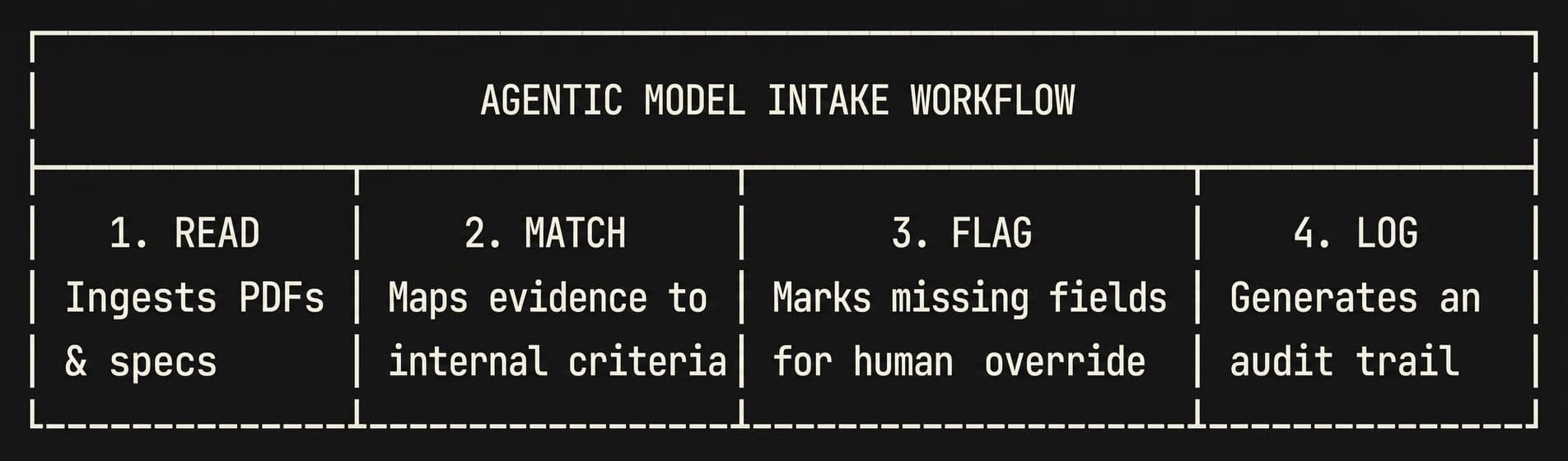
Step 1: Read model documentation and intended-use statements
Intake marks the official entry point of the model lifecycle, making document extraction the agent's first operational task. Every model enters a unified inventory the moment it’s proposed, capturing risk and materiality before or while development or validation begins.
The agent parses uploaded specification files, architecture diagrams, and policy documentation. For external or vendor models, a specialized search agent can pull supplementary documentation from approved repositories. For internal models, it evaluates all live development context, including versioning, code repos, and performance metrics. It then drafts the intake questionnaire, explicitly leaving fields blank wherever documentation is missing or inconclusive.
Step 2: Match evidence against risk-tier criteria
Once the agent extracts the documentation, it shifts from reading context to evaluating risk. The agent operates within an organization’s specific tiering grid, materiality matrices, and policy conditions. It compares extracted model characteristics against these rules and proposes a risk classification, such as Low, Medium, High, or Critical, along with a detailed written rationale. It then recommends applicable governing policies, which system administrators can restrict or pre-approve.
Step 3: Flag ambiguous cases for human review
Because no agent should make autonomous policy decisions, the workflow explicitly highlights uncertainty. Wherever documentation is incomplete, the agent flags the field rather than guessing. When presenting its proposed tier, the underlying rationale and supporting source snippets are rendered side by side.
Human reviewers maintain full authority to edit or override any agent output at any step. Once reviewed, the decision routes through a firm's documented escalation workflow, logging who signed off and at which step.
Step 4: Log the audit record
Finally, the agent compiles every action taken during the review into an immutable history. The resulting compliance record captures all system changes, including the proposed tier, human overrides, written rationale, supporting evidence snippets, applied policies, and complete inventory history.
At the system level, the platform logs every LLM call, tool dispatch, and decision point at the span level to record token consumption, execution latency, and compute cost. This ensures that when an internal auditor or regulatory examiner asks for proof, a complete execution trail already exists. However, an agent can only generate this audit trail if the agent itself operates within strict operational boundaries.
How to govern an AI agent that tiers models
Because an agent that tiers models is itself an AI system, financial institutions must establish strict governance controls before allowing it to process intake. Without explicit guardrails, organizations risk scaling unmonitored agentic workflows that fail under regulatory scrutiny. Successfully deploying agentic intake requires moving beyond building an agent to running it with continuous, auditable monitoring.
The need for specialized controls stems from how agents execute. A traditional model produces a single output that can be evaluated once. An agent produces a multi-step execution chain featuring a sequence of tool calls, dynamic planning, and external data retrieval. A subtle error early in that chain can compound downstream, and a simple review of the final output will miss it.
In model risk management, governance requires provable oversight. Financial institutions must establish three core controls before an agent touches risk tiering:
1. Containment: scoping access to the model and AI systems inventory
Risk teams must enforce a strict perimeter around what the agent can read, invoke, and write. Establish an approved list of authorized tools, enforce hard sign-off gates where human approval is required, and govern tool access through a secure API gateway across the entire model and AI systems inventory. Administrators must retain the ability to restrict which policies the agent can recommend and shut off AI tiering while allowing manual intake to continue uninterrupted.
2. Tracing and reproducibility: automatic logging of every judgment
Independent validators and auditors must be able to replay every execution run. Multi-agent interactions, LLM calls, and tool executions must appear in a unified trace view so validators can isolate compounding errors back to their origin. Administrators should have the ability to restore any historical run to its exact state and re-execute it with a single click.
3. Human review: retaining risk and compliance oversight
Human-in-the-loop controls ensure that named risk officers retain ownership over final governance decisions. Explicitly define who owns tiering rules, who holds override authority, and what steps a reviewer must complete before a tier becomes official. Every decision routes to designated reviewers through a logged escalation path, keeping the risk officer in control.
What to track in an agentic AI pilot for model governance
Before deploying agentic intake at scale, establish a manual baseline that captures current intake completion times and tiering consistency. Evaluate your pilot against two key operational categories:
Intake completeness and efficiency
- Field completion rate: measure the percentage of questionnaire fields the agent correctly populates vs. the share left blank due to insufficient source documentation.
- Time to inventory: track total elapsed time from initial model submission to a finalized, audit-ready inventory record.
Tier agreement, stability, and cost
- Human-agent agreement rate: compare proposed agent tiers against final human risk officer decisions, tracking override frequency over time.
- Classification stability: a model’s risk tier should not drift unless the underlying model or intended use materially changes. Test stability by running a benchmark high-risk model through intake periodically to verify output consistency.
- Unit economics: utilize span-level tracing to monitor token usage, API latency, and compute cost per model intake.
Taking the next step in model governance
Automating model intake and risk tiering eliminates the manual document review that stalls validation before it begins. Combining agentic document parsing with a deterministic rules engine lets financial institutions speed model intake while maintaining full auditability and control.
See how Domino deploys agents to streamline model intake and tiering securely. Watch the demo.