Enterprise design patterns for multi-agent AI workflows
Five structural approaches that reduce coordination failure at enterprise scale



Multi-agent orchestration, the coordination of multiple AI agents across a shared workflow, allows systems to divide work and exchange information on tasks that exceed a single agent's reliability limit. Getting individual agents to execute is straightforward, but the real enterprise challenge is preventing conflicting outputs, unbounded compute consumption, or silent failures. This is where most enterprise implementations break down.
Design patterns exist to give teams a starting point beyond "figure it out from scratch." The five patterns covered here describe different coordination structures with known tradeoffs, and each addresses a different class of problem. Choosing the right one, before building, saves the rework that follows failures in production.
Why multi-agent orchestration needs design patterns
Without established patterns, teams end up with coordination logic hardwired into prompts and small custom scripts stitched together as an afterthought. These one-off implementations work at first, but break when an agent returns an unexpected result, a tool call times out, or the system hits a concurrency limit. Debugging a custom orchestration layer is expensive, and failure modes tend to surface at the worst time, under production load.
Patterns reduce that risk by encoding decisions about coordination topology, failure handling, and state management that other teams have already validated. For teams already using retrieval-augmented generation (RAG) in production and considering a move to multi-agent systems, the architectural differences between RAG-based and agentic approaches clarify why multi-agent orchestration requires a different set of design decisions.
This structural predictability solves more than just engineering headaches; it provides the mandatory foundation for formal risk management. Enterprise AI systems in regulated industries carry strict audit requirements. When an agentic workflow produces an incorrect answer, reviewers must trace which agent produced the intermediate result and why. Building the system on explicit coordination patterns instead of ad hoc prompt handoffs localizes the coordination logic, allowing reviewers to reliably instrument it with audit logging.
Industry standards now heavily reflect this shift toward predictable topologies. Anthropic's guidance on building effective agents explicitly advocates for structured routing and rigid handoffs over fully autonomous prompt chains. Similarly, the LangGraph multi-agent documentation demonstrates how graph based coordination models keep complex, stateful agent interactions observable.
The building blocks of multi-agent workflows
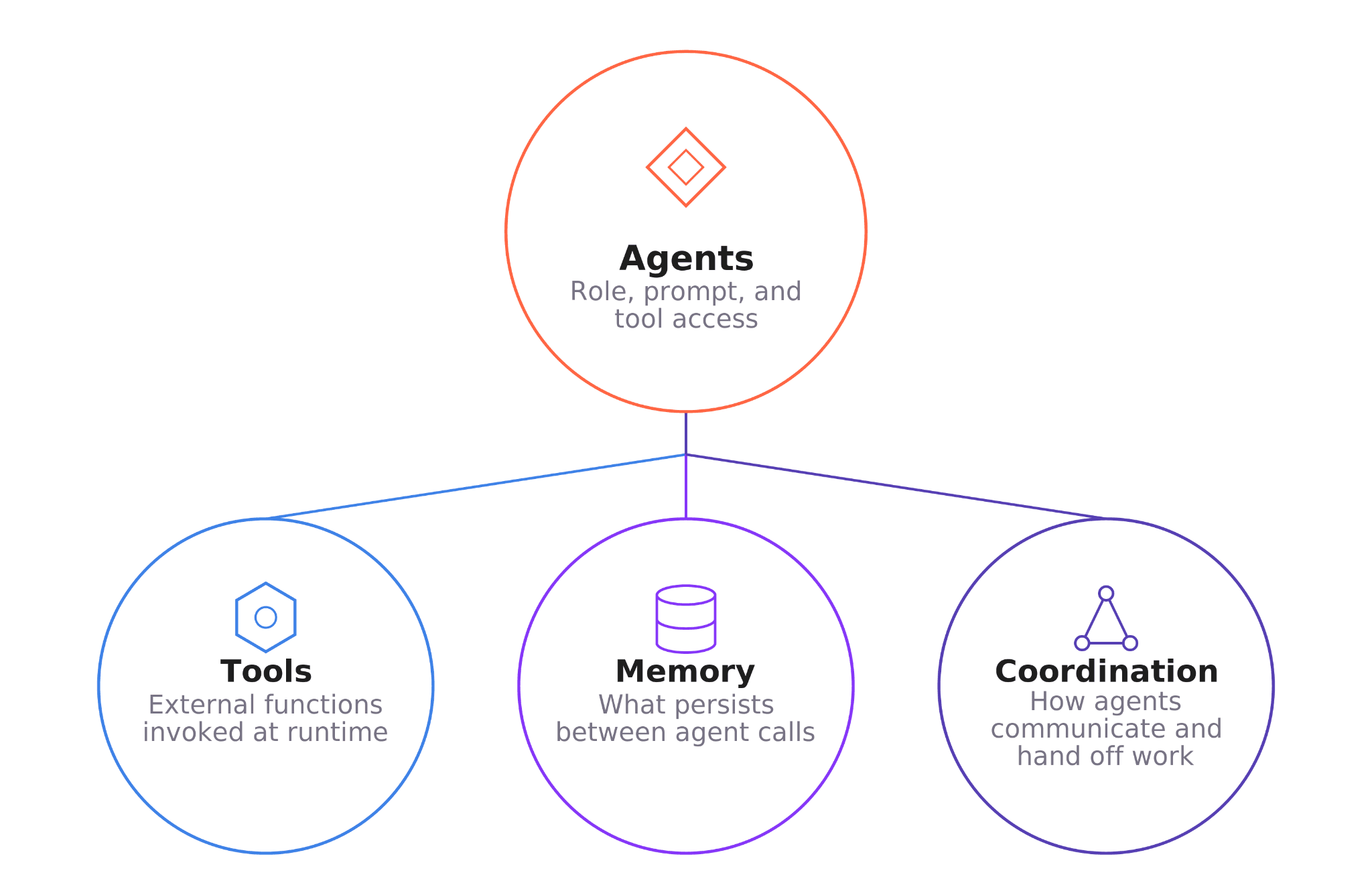
Four primitives define the structure of any multi-agent system:
- Agents are LLM instances with a defined role, a system prompt, and optionally tool access. An agent's behavior is shaped by its instructions and what it can observe at call time.
- Tools are external functions an agent can invoke at runtime including database queries, web search, code execution, document retrieval from a knowledge base, or API calls to external systems.
- Memory is what persists between agent calls. In-context memory is what fits in the current prompt window. External memory is a vector store or key-value store agents query between calls. Episodic memory, a structured log of past interactions, supports more complex, stateful workflows where agents need to know what was already attempted.
- Coordination is how agents communicate including sequential handoff, one task splitting out to several agents working in parallel, a shared state object, or an event bus.
Moving beyond basic prompt engineering means treating these elements as architectural building blocks, and the patterns below illustrate the most reliable ways to assemble them in production.
Planner-executor pattern
How the pattern works
A planning agent receives the top-level goal and decomposes it into a structured list of subtasks. Executor agents take those subtasks, carry them out, and return results. A synthesis step then assembles the results into a coherent output, either a separate reducer agent or the planner itself in a second pass, depending on how complex the assembly needs to be.
This pattern relies on strict separation of concerns, ensuring the planner never interacts directly with a database and executors never handle decomposition logic.
Annotated example
For a drug interaction analysis workflow at a life sciences team, the planner receives a query about two compounds and generates three subtasks: literature search via PubMed, molecular property lookup from an internal database, and toxicity flag review against a regulatory reference set. Three executor agents run against their respective data sources in parallel, and a synthesis agent assembles the results into a structured report formatted for a scientific reviewer.
This separation makes it easy to replace one executor, swapping the PubMed search agent for an internal clinical trial database agent, without changing the planner or synthesis step.
Design tradeoffs
The planner's quality determines everything downstream. If the decomposition is wrong, executors work on the wrong subtasks, and no amount of execution quality recovers from that. Planner outputs need validation, especially for complex problems where the task space isn't well-defined upfront. This pattern suits multi-agent AI coding workflows and structured research pipelines, where tasks can be clearly specified before execution begins. It’s less effective when the goal is ambiguous and the right decomposition doesn't become clear until execution is already partway done. That class of problem is better served by a memory-driven or event-driven approach.
Supervisor (coordinator) pattern
How the pattern works
A supervisor agent receives the incoming request, classifies it, and routes it to the appropriate specialized sub-agent. Unlike the planner-executor, there's no separate decomposition step. Classification and delegation happen in the same pass. Orchestration agents in this role assign tasks. They do not execute them. The supervisor monitors each sub-agent's output and either returns it directly or routes to a second agent for follow-up or escalation. The supervisor holds the routing logic while the sub-agents hold the domain knowledge.
Annotated example
For a customer service automation system built as a three-tier structure, the supervisor classifies each incoming inquiry, whether billing, technical support, account management, or churn risk, and routes it to the corresponding sub-agent. Sub-agents are tuned for their domain with targeted system prompts and restricted tool access. When a sub-agent returns a low-confidence answer, the supervisor routes to an escalation agent with a broader context window and permission to access the full customer record.
Design tradeoffs
The supervisor acts as both the coordinator and a single point of failure. Routing every request through it adds latency and creates a bottleneck at scale. Routing logic requires ongoing maintenance as subagent capabilities evolve. This pattern excels when handling distinct specializations with clear classification signals but struggles when incoming requests span multiple domains, often resulting in routing errors or supervisors inappropriately handling edge cases.
Tool-centric agent pattern
How the pattern works
Agents are defined by tool access rather than fixed roles. A tool registry holds available tools with structured descriptions. Each agent invocation includes the current tool set, and the agent selects and invokes tools at runtime based on the task at hand.
Annotated example
For a research assistant workflow, agents can invoke any combination of four tools: a vector store retrieval tool for the internal knowledge base, a web search API, a Python code executor for data analysis, and a citation formatter. The agent prompt stays constant across invocations. Behavior changes based on which tools are relevant. An agent building a competitive analysis uses web search and the formatter. An agent answering an internal technical question uses the retrieval tool and the code executor. What the agent can do depends on the tool registry, and that registry can change with every invocation.
Design tradeoffs
Tool selection errors compound through a workflow. A small mistake in tool choice or argument formation propagates and produces outputs that are hard to diagnose after the fact. That is because the error sits in the path through the system rather than in any single agent's output, which is exactly why tool descriptions need to be unambiguous and non-overlapping. This pattern works well when the task space is broad but the tool boundaries are clean. Governance is where it gets harder. The execution path varies with each invocation, which makes audit logging harder to standardize across runs.
Memory-driven agent pattern
How the pattern works
While the previous patterns rely on active routing or direct tool execution, this approach uses state as the primary coordinator. Agents read from and write to a shared memory store that persists state across calls, sessions, or agent boundaries. This pattern draws on all three memory layers already introduced: in-context, external, and episodic. Agents collaborate by querying memory before acting and writing results back for other agents to use.
Annotated example
For a competitive intelligence workflow, five agents each research a different market segment and write a structured findings summary to a shared vector store on completion. A synthesis agent, triggered after all five complete, queries the store across all segments and produces a combined executive brief. No agent knows what the others found during their run. The memory store is the coordination mechanism, so no explicit inter-agent communication is needed.
Design tradeoffs
The failure mode to watch for here is memory consistency. If two agents write conflicting entries, or one agent's summary overwrites another's, the synthesis agent ends up building on unreliable inputs. That is why memory-driven patterns require explicit write semantics, which is who writes what, in what format, under what conditions, as well as conflict resolution rules. Retrieval quality matters just as much as write discipline. A poorly indexed vector store returns irrelevant context and leads agents to build on stale information. Governance for this pattern has to extend further than usual too, logging not just agent outputs but memory read and write operations, which most standard logging setups don't capture by default.
Event-driven multi-agent workflow
How the pattern works
Instead of being invoked directly, agents wait for specific system triggers. When an agent completes a task or detects a condition, it broadcasts a signal. Any downstream agents programmed to look for that specific signal automatically wake up and execute their work, often running in parallel. This removes the need for rigid, step-by-step handoffs and prevents agents from being bottlenecked by a central coordinator.
Annotated example
For a model monitoring pipeline, a drift-detection agent computes metrics on a schedule and publishes a "drift threshold exceeded" event when metrics cross a defined limit. Three subscribers fire in parallel in real time. A retraining agent queues a new training job, a notification agent sends an alert to the model owner, and a compliance logging agent writes the event to the audit trail. The drift-detection agent has no direct coupling to any of the three downstream agents. So adding a fourth subscriber, a cost-impact analysis agent for example, requires no changes to the existing agents.
Design tradeoffs
Event-driven workflows are harder to debug because there's no single call stack to read. The execution trace is scattered across agents and the event log instead, and a failure in one subscriber doesn't automatically surface to the others. This pattern works well for asynchronous monitoring pipelines and workflows where parallel execution is genuinely warranted. It's poorly suited to workflows that require strict ordering or where one agent's output feeds directly into the next. Infrastructure overhead is real too. You need a reliable message queue, versioned event schemas, and a strategy for handling event replay when a subscriber fails.
Choosing between AI agent patterns for enterprise systems
Selecting the correct architecture depends on whether the task is deterministic, whether the subtask structure is known upfront, and how strict the auditability requirements are.
The following table maps each pattern to its primary use case, coordination mechanism, and strongest governance property.
Pattern
Best for
Coordination mechanism
Governance strength
Planner-executor
Structured research, report generation, coding workflows
Sequential task list
Task decomposition audit trail
Supervisor
Customer service, routing-heavy workflows
Centralized router
Escalation and routing logs
Tool-centric
Open-ended research, broad tool access
Runtime tool selection
Tool invocation logs
Memory-driven
Multi-session workflows, distributed research
Shared stale store
Memory read/write audit
Event-driven
Monitoring pipelines, async workflows
Message bus
Event log and subscriber trace
For most enterprise teams building their first production multi-agent system, the planner-executor pattern offers the best starting balance. The decomposition is auditable, executors are replaceable, and failure modes stay localized to individual steps. Supervisor patterns fit when the incoming request space maps cleanly to discrete specializations, while memory-driven and event-driven patterns add infrastructure complexity that's only worth taking on when the coordination problem actually requires it.
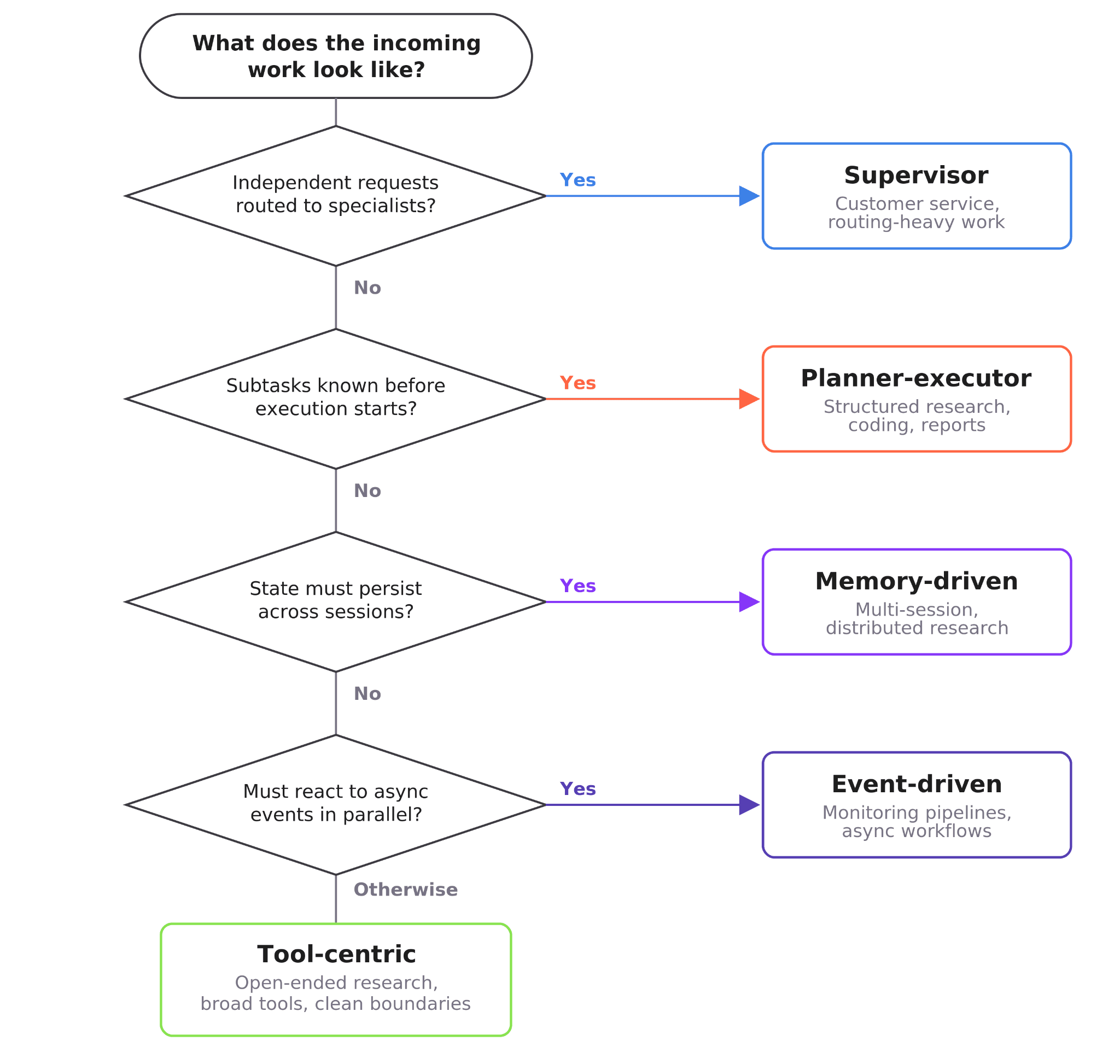
Real-world production systems often combine patterns. A supervisor might route requests to planner-executor workflows for complex tasks and to single-step tool-centric agents for simpler ones. The important constraint is that every boundary between patterns stays explicitly defined and observable, because undocumented pattern mixing is how audit trails break.
Why enterprise platforms matter for multi-agent orchestration
Running multi-agent systems in a regulated enterprise environment introduces requirements that prototype-grade frameworks don't address. Every agent invocation needs to be traced, attributed to a specific run, and linked to the data and tools it touched. For organizations operating under GxP validation requirements or the EU AI Act, an incomplete execution trace is a compliance failure. Financial services teams don't get cover from SR 26-2 either. The Fed, OCC, and FDIC's revised model risk management guidance explicitly excludes generative and agentic AI from its scope, which leaves institutions to govern those systems through their own risk-management practices rather than a prescribed model-validation checklist.
An enterprise AI platform needs to capture the full execution context for an agentic workflow. This includes which agents ran, in what sequence, with what tool inputs and outputs, against which version of the underlying models and retrieval indexes. That context is what makes a multi-agent system auditable rather than just functional, and it's also where a lot of proof-of-concept work falls short once it reaches production. Governance requirements differ by workflow type, and the pattern that works well in a demo often fails to meet the traceability requirements of a production deployment, especially as agentic automation extends across enterprise workflows. The coordination pattern you choose also shapes observability, governance, and how hard the system is to debug. Domino's 2026 Enterprise AI Report, which surveyed 639 senior AI leaders at $100M+ enterprises, found organizations with fully integrated governance are 3.9 times as likely to have agentic AI running in governed production as those only partially keeping pace.
Frequently asked questions
What is multi-agent orchestration in enterprise AI systems?
Multi-agent orchestration is the coordination of multiple AI agents so they can divide work, exchange information, and produce a combined output on tasks that exceed what a single agent handles reliably. In enterprise systems, this typically means one or more agents handling planning or routing, specialized agents handling execution, and infrastructure managing state, memory, and tool access between them. Common coordination structures include planner-executor decomposition, supervisor-based routing, and event-driven publish/subscribe, each suited to different task shapes and auditability requirements. The core challenge is keeping the coordination layer reliable when agents fail, produce inconsistent outputs, or consume more compute than expected.
Why are design patterns important for multi-agent workflows?
Design patterns give teams a tested coordination structure rather than requiring each team to derive one from scratch. They encode decisions about topology, failure handling, and state management that have been validated in real deployments. They also improve observability: workflows built on explicit patterns are easier to instrument for audit logging and debugging than those where coordination logic is embedded in ad-hoc prompt chains. A pattern-based approach also makes it easier to reason about failure modes before they surface in production, since the coordination logic follows a known shape rather than being scattered across glue code. For enterprise teams subject to model governance requirements, a known shape is what lets someone trace the source of a wrong output during an incident.
When should teams use multi-agent architectures instead of a single agent?
A single agent is sufficient when the task fits within one context window and doesn't require parallel execution or multiple tool specializations. Multi-agent architectures are warranted when the task requires decomposition into distinct subtasks that benefit from parallelization, when different subtasks need different tool access, or when execution latency can be meaningfully reduced by running subtasks concurrently. The overhead of multi-agent coordination (additional latency, debugging complexity, and infrastructure cost) needs to be justified by what the task actually requires. Teams evaluating that tradeoff should also weigh how strict their auditability requirements are, since a pattern like planner-executor produces a clearer decomposition trail than a looser, ad-hoc architecture. Most workflows that look like they need a large fleet of agents turn out to need two or three well-designed ones.
What challenges arise when coordinating multiple AI agents?
The primary challenges are state consistency, failure propagation, and cost management. When agents share memory or state, write conflicts and stale reads produce unreliable downstream outputs. When one agent in a sequential chain fails or returns a low-confidence result, downstream agents may execute on incomplete inputs without detecting the error. These challenges compound when patterns are mixed without clear boundaries, since undocumented handoffs between coordination structures are a common source of audit trail gaps. On cost, agents that call tools or invoke other agents in loops consume compute and API quota faster than single-agent runs. Token budgets and retry limits need to be set explicitly rather than relying on framework defaults, which are typically set for development workloads, not production ones.
How do memory systems affect multi-agent AI workflows?
Memory determines what context agents can share across calls and across agent boundaries. An agent memory framework limited to in-context memory constrains each agent to its current prompt window, which prevents state accumulation across a long workflow. External memory (vector stores, key-value stores) lets agents build on each other's work across a session. Episodic memory allows agents to check what was already attempted before taking an action, reducing redundant work in long-running pipelines. The tradeoff is that richer memory systems require explicit read and write semantics, conflict resolution rules, and retrieval quality monitoring. A vector store with poor indexing returns stale or irrelevant context, which leads agents to repeat work or build on incorrect information without any signal that something went wrong.