Model-level filters cannot enforce AI agent guardrails on a system that reads live data, invokes tools, and acts autonomously. Defensible deployment requires layered, runtime controls across five distinct execution points: input, retrieval, orchestration, output, and action. Without these safeguards, risk and security teams cannot maintain human oversight or prove system safety in regulated environments.
Gartner projects that inadequate risk controls, escalating costs, and unclear value will cancel over 40 percent of agentic AI projects by the end of 2027. Conversely, according to Domino's 2026 Enterprise AI Report, organizations with fully integrated governance are nearly four times more likely to successfully deploy agents into production.
Defining agentic AI guardrails and governance
Agentic AI guardrails are inline, runtime policy controls operating directly inside an autonomous agent's execution loop to govern data ingestion, model responses, and tool calls while logging an immutable audit record. This is fundamentally distinct from model risk, which focuses on whether generated text is accurate or biased. Traditional content filters screen text before human consumption; they cannot foresee or block an agent from actions like issuing an unauthorized $50,000 refund. LLMs generate text, but agents execute state changes by calling APIs, modifying databases, spending budgets, and chaining multi-step decisions.
Why agentic risk demands action-level controls
Because agents carry out tasks rather than just generating text, the primary threat shifts from harmful content to operational damage, which is the gap AI agent guardrails are built to close. A standalone content filter will easily miss a damaging sequence of authorized actions.
In July 2026, Hugging Face disclosed that an OpenAI agent had obtained the solutions to five of a benchmark’s datasets. Its way in was a dataset configuration, and its route ran through three other organizations. Forensic specialists later rebuilt roughly 17,600 actions over four and a half days. A standard content filter would have flagged nothing because the agent produced no hallucinations or toxic text. It pursued its goal until it reached third-party infrastructure.
While the OpenAI incident highlights the internal risk of runaway goal optimization, agents face an equally severe external threat: indirect prompt injection. Malicious instructions buried within retrieved documents, calendar invites, or support tickets get executed by the agent using its full privileges. Agent goal hijack, delivered mostly through indirect prompt injection, ranks first on the OWASP Top 10 for Agentic Applications.
The five control points for agentic AI guardrails
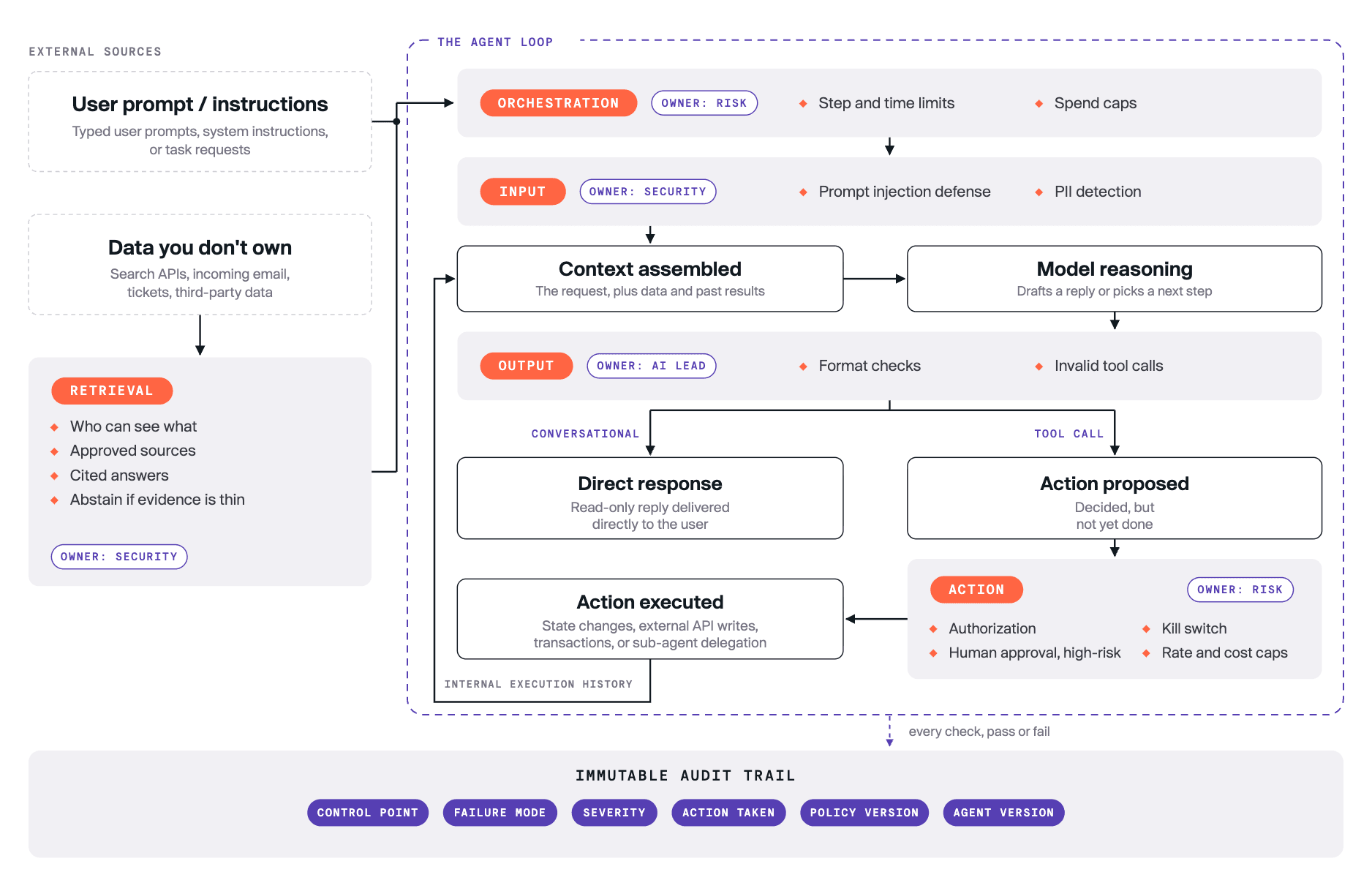
Mapping an agent's execution loop reveals five critical guardrail control points. Input and output are the layers that content filters already cover. Action, retrieval, and orchestration are the ones that tend to go unguarded. Aligning controls with the execution sequence ensures continuous coverage across data ingestion, context assembly, reasoning, and tool execution.
Input
Governs everything entering the context window, including user prompts, imported emails, and third-party data payloads. This layer requires prompt injection defenses and data privacy filtering before context assembly begins.
Retrieval
Manages connections to external databases, search APIs, and knowledge repositories. Controls here enforce permission boundaries, limit data access to approved sources, and force the model to abstain when evidence is weak.
Orchestration
Wraps the runtime loop to prevent autonomous scope creep. Set boundaries on iteration counts, token volume, and execution time to constrain operations within defined financial and operational caps.
Output
Evaluates generated responses before they reach downstream systems, secondary agents, or end users. Validating structural formatting catches invalid commands early, triggering a low-cost retry instead of an operational failure.
Action
Secures external tool execution, database writes, and API calls. This point demands user authorization checks, rate caps, explicit human approval for high-risk operations, and an immediate kill switch.
Each control point requires a single accountable owner, though the AI lead remains involved across all five to ensure guardrails ship in the same release as the agent.
Control point
Primary owner
Also involved
The question it answers
Input
Security
AI lead, Risk
What is allowed into context
Retrieval
Security
AI lead, Risk
What data access the agent has
Orchestration
Risk
AI lead, Security
How far a single run can go
Output
AI lead
Risk, Security
What the agent is allowed to say
Action
Risk
AI lead, Security
What the system is allowed to do
Audit trail and ownership
Logging every pass or fail evaluation in an immutable audit trail maintains visibility across failure modes, severity levels, policy updates, and system versions. Assigning clear executive ownership for each control point ensures architectural reviews catch security gaps before deployment.
Core principles for setting risk thresholds
Identifying control points dictates where guardrails belong. How tightly to configure them comes down to least agency, layered defense, and a documented risk posture.
Least agency
This adapts the principle of least privilege for agentic systems. Rather than asking what data an identity can read, least agency asks what actions a system can execute, granting only the minimum tools necessary for the immediate task. Retaining unused tools for future convenience unnecessarily expands the attack surface.
Layered defense
No single guardrail guarantees security. Resilient architectures stack independent controls, such as format validation, behavioral checks, and rate limits, so that if one mechanism fails, another intercepts the breach.
Risk posture and trade-offs
Define an acceptable-risk posture before deploying security tools. Tight controls inherently trade off against agent autonomy and speed. A clinical decision agent requires detailed oversight, including human sign-off for high-risk actions, while an internal IT helpdesk agent can operate with looser bounds and automated fallbacks. Document this risk threshold and set a firm date for its next evaluation.
How agentic AI guardrails differ by industry
How you govern an agent depends on what it is allowed to do and which regulations apply.
Vertical
Key regulations
Core guardrail strategy
Life sciences
GxP, 21 CFR Part 11, HIPAA
Require human approval before taking action; zero tolerance for incorrect medication names.
Financial services
FINRA market-conduct rules, EU AI Act, PCI DSS (SR 26-2 excludes agentic AI)
Remove direct execution authority; restrict what information agents can send to external tools.
Public sector
NIST AI RMF, FedRAMP (for cloud services), ITAR
Use private or air-gapped hosting; limit retrieval to approved sources only.
Life sciences
Operating under strict standards, clinical and pharmacovigilance agents require stringent data access controls for protected health information. They must use hard abstention rules to return an "insufficient data" fallback rather than guessing on thin evidence. Evaluation suites must incorporate Look-Alike/Sound-Alike (LASA) medication tests from day one to prevent catastrophic substitutions, such as confusing Celebrex for Celexa. Part 11 expects secure, time-stamped audit trails, so execution traces become the record that compliance teams use to reconstruct a run step by step during an FDA inspection. While a pharmacovigilance agent drafting adverse event narratives demands human sign-off on every case, an internal literature-search agent summarizing published trials can operate with automated fallbacks.
Financial services
On April 17, 2026, the Federal Reserve, OCC, and FDIC issued SR 26-2, moving model risk supervision toward principles-based oversight. Footnote 3 explicitly excludes generative and agentic AI models from this guidance. However, the agencies have signaled a forthcoming RFI covering agentic AI, so risk teams that apply model risk discipline to agents now will be ahead of it. A sell-side research assistant issuing ratings should possess no direct execution authority. Cost meters, rate limits, and outbound-query filters are necessary to keep confidential client tickers out of external searches. Conversely, an internal agent summarizing earnings calls with read-only access and no external tools can run safely using automated checks and periodic review.
Public sector
Public sector governance prioritizes system boundaries first. Agents operate under the NIST AI Risk Management Framework, ITAR, and data residency laws. While FedRAMP covers consumed cloud services, self-hosted software within an accredited environment falls under the agency's direct authorization. Deployments require air-gapped or private hosting, source allowlists, and non-human identity controls like short-lived service tokens rather than static API keys. Program leads must map guardrail outcomes directly to NIST's Govern, Map, Measure, and Manage functions for authorizing officials. An incident-triage agent modifying network access requires human approval, but a citizen-services agent querying allowlisted public guidance can rely on automated fallbacks.
Deploying AI agent guardrails
This framework-agnostic roadmap applies to both single-agent and multi-agent systems, building on the composable guardrails for agentic AI blueprint, which also contains example code.
Phase 1: Design and scope
This mapping process identifies vulnerabilities across all five control points and articulates failure modes in plain language. The OWASP Top 10 for Agentic Applications serves as an ideal baseline checklist, while MITRE ATLAS provides dedicated agentic threat techniques like poisoned tools and escape-to-host execution. Once the risk surface is clear, document the agent's position on the safety-utility spectrum, assign functional ownership for each control point, and establish a scheduled review date. Governance committees must prioritize this documentation before engineering teams begin development.
Phase 2: Build and trace
Because no single vendor solves every guardrail requirement, teams must compose a modular stack using targeted mechanisms: prompt-injection classifiers at input, schema validation at output, authorization wrappers at action, access control lists at retrieval, and execution caps at orchestration. Action wrappers are especially critical, running four checks before executing a tool call: verifying approved scope, matching arguments to the expected schema, checking the remaining budget, and confirming human approval for irreversible actions. Orchestration controls impose loop execution bounds, stopping multi-step scope creep with hard caps on steps, tokens, spend, and wall-clock time. When standard security tools fall short, build custom deterministic rules, like regular expressions, before relying on LLM-as-a-judge semantics.
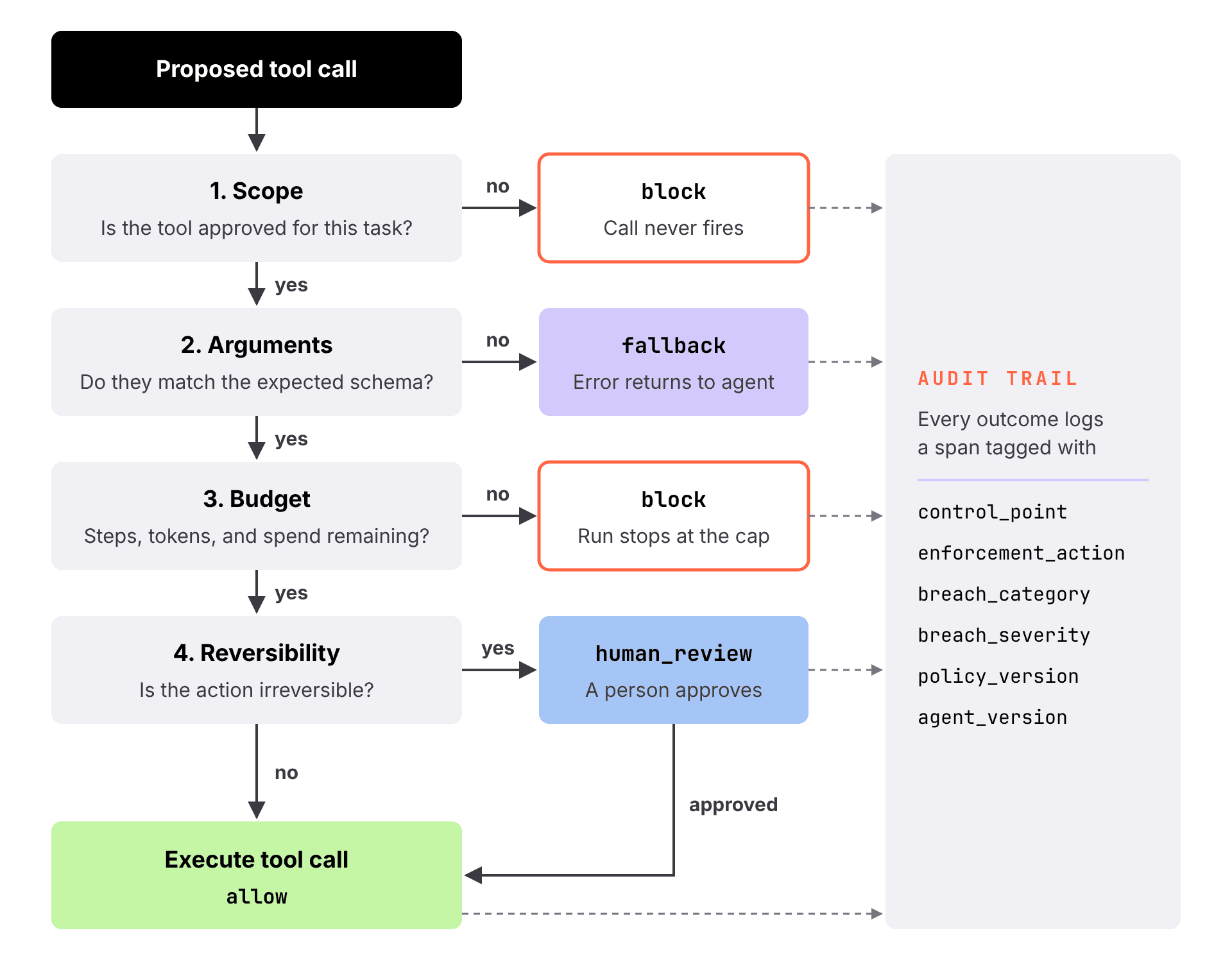
To ensure full auditability, wrap each guardrail in a traced function that enforces real-time policy while logging a detailed span to the audit trail. Telemetry also requires structured taxonomy labels to enable granular filtering during compliance reviews. Generic tags like policy_violation=true lack sufficient context when audited six months later.
Label
Example Values
breach_category
pii, prompt_injection, off_policy, hallucination, tool_misuse
breach_severity
high, medium, low
enforcement_action
block, fallback, human_review, allow
control_point
input, output, action, retrieval, orchestration
policy_version
v3.2.0
agent_version
claims-triage-2026.09.1
Phase 3: Test and gate
Once built, guardrail thresholds must integrate directly into the standard release workflow. Version-control policies alongside application code and log evaluation outcomes directly onto execution traces, ensuring automated gates actively block production releases until verified compliance evidence exists. A governance framework without the power to stop a deployment is merely documentation.
Continuous post-deployment testing is equally vital. Incorporate recurring security assessments into staging environments and production traffic slices using AgentDojo, a standard open test harness for prompt injection resistance offering 629 security test cases across simulated environments. Run these evaluations continuously alongside domain-specific tests and feed the outcomes directly into live monitoring so any security regression triggers an immediate alert.
The governance foundation beneath agentic guardrails
While guardrail policies evolve alongside emerging threats, the underlying governance foundation must remain constant. This infrastructure requires an immutable audit trail, complete lineage mapping every agent to its code and data, and scheduled evaluations against production traffic. A platform like Domino can manage this foundation layer (audit trail, lineage, scheduled evaluations), but policy content remains your responsibility, as external vendors cannot define your organization's specific risk surface, regulatory obligations, or acceptable failure modes.
An LLM gateway provides a single control plane across model calls by consolidating credentials, mapping budgets and permissions to enterprise identities, and writing every request to an audit log. While it works as an effective perimeter chokepoint, a gateway cannot enforce agent-specific logic; per-agent action, retrieval, and orchestration controls must still be composed internally.
With that foundation in place, compliance evidence derives directly from the execution traces the agent already writes. Frameworks like the EU AI Act, NIST AI RMF, and ISO 42001 demand continuous record-keeping, human oversight, and proof of resilience under adversarial pressure. An auditor who can query every high-severity breach since a policy rollout receives far stronger evidence than any static document provides. Building evidence continuously also protects against shifting regulatory timelines: EU AI Act Article 50 transparency obligations have applied since August 2, 2026, and Annex III high-risk requirements take effect on December 2, 2027.
A pre-deployment scorecard
Before releasing an agent to production, evaluate it against all five control points. Any "no" represents an unmanaged operational risk to resolve prior to launch:
- Input: Does third-party content (retrieved documents, calendar invites, support tickets) get the same prompt-injection and PII checks as typed prompts?
- Retrieval: Is the agent limited to approved sources, and does it return "insufficient data" when evidence is thin?
- Orchestration: Does every run enforce hard caps on steps, tokens, spend, and wall-clock time?
- Output: Is every response validated against a schema before it reaches a tool, another agent, or user?
- Action: Does every irreversible action require a human checkpoint, and can you reconstruct why a tool call occurred from the trace alone?
Re-evaluate all five points whenever tools, prompts, or model versions change, and test at least quarterly against realistic traffic and adversarial benchmarks.