  • Agentic AI
  • AI Governance
  • Airflow
  • Anaconda
  • Apache Spark
  • Artificial Intelligence
  • Clustering
  • Dask
  • Data Science
  • Density-based clustering
  • dplyr
  • Factor analysis
  • Feature
  • Feature Engineering
  • Feature Extraction
  • Feature selection
  • Folium
  • GenomicRanges
  • ggmap
  • ggplot
  • GPU
  • Ground Truth
  • Hash table
  • Hyperparameter Tuning
  • Interpretability
  • Jupyter Notebook
  • Kubernetes
  • LLMOps
  • Machine Learning
  • Machine Learning Algorithms
  • MLOps
  • Model Drift
  • Model Evaluation
  • Model monitoring
  • Model Selection
  • Model Tuning
  • Overfitting
  • Plotly
  • PySpark
  • PyTorch
  • Responsible AI
  • Shiny (in R)
  • sklearn
  • spaCy
  • SR 26-2
  • Statistical Computing Environment (SCE)
  • TensorFlow
  • Underfitting
  • XGBoost
  • Factor analysis

    What is factor analysis?

    Factor analysis is a statistical method used to describe variability among observed, correlated variables in terms of a potentially lower number of unobserved variables called factors. For example, it is possible that variations in six observed variables mainly reflect the variations in two unobserved (underlying) variables.

    Factor analysis searches for such joint variations in response to unobserved latent variables. The observed variables are modelled as linear combinations of the potential factors, plus “error” terms. Factor analysis aims to find independent latent variables.

    Basic factor analysis illustration
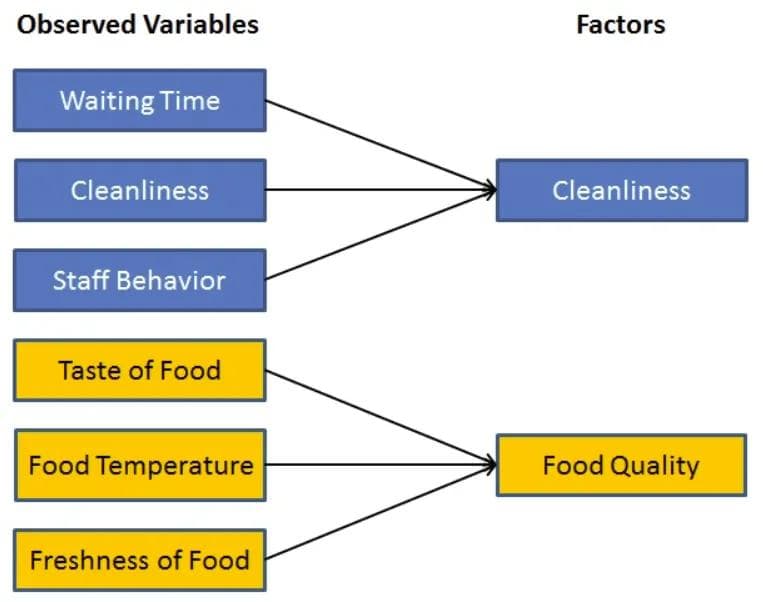
    Illustration of factor analysis
    Illustration of factor analysis

    Source: DataCamp

    Factor analysis is a way to take a mass of data–or multiple variables–and shrinking it to a smaller number of variables that are more manageable and more understandable. More technically, running a factor analysis is the mathematical equivalent of asking a statistically savvy oracle the following: “Suppose there are N latent variables that are influencing people’s choices. Tell me how much each variable influences the responses for each item that I see, assuming that there is measurement error on everything”. Often the behavior or responses that are being analyzed comes in the form of how people answer questions on surveys.

    Factor analysis aims to give insight into the latent variables that are behind people’s behavior and the choices that they make. Principal Component Analysis (PCA), on the other hand, is all about the most compact representation of a dataset by picking dimensions that capture the most variance. This distinction can be subtle, but one notable difference is that PCA assumes no error of measurement or noise in the data; all of the noise is folded into the variance capturing.

    Implementing factor analysis

    Several factor analysis libraries and packages are available to data scientists, including:

    • Factor analysis in R is available with the “Psych” package
    • FactorAnalysis in sklearn (sklearn.decomposition.FactorAnalysis) is a Python option
    • The “factor_analyzer” package is another Python option

    Summary

    • Basic factor analysis illustration
    • Implementing factor analysis
    Home
    Contact us
    Watch Demo
    Contact us
    Watch Demo
    Domino's logo

    Who is Domino?

    Domino Data Lab empowers the largest AI-driven enterprises to build and operate AI at scale. Domino’s Enterprise AI Platform provides an integrated experience encompassing model development, MLOps, collaboration, and governance. With Domino, global enterprises can develop better medicines, grow more productive crops, develop more competitive products, and more. Founded in 2013, Domino is backed by Sequoia Capital, Coatue Management, NVIDIA, Snowflake, and other leading investors.

    Watch Demo
    • Platform

        • AI infrastructure
        • Data management
        • AI workbench
        • MLOps
        • AI governance
        • FinOps
        • Pricing
        • Security & compliance
        • What's new
    • Solutions

      • Industries

        • Life sciences
        • Finance
        • Public sector
        • Retail
        • Manufacturing
      • Use Cases

        • Generative AI
        • Cost-effective data science
        • Self-service data science
        • Model risk management
        • Cloud data science
    • Learn

        • Events
        • Blog
        • Podcast
        • Courses and certifications
        • Data Science Dictionary
        • Documentation
        • Support
        • Demo hub
    • Company

        • About
        • Why Domino
        • Careers
        • News and press
        • Partners
        • Customers
        • Contact us

    © 2026 Domino Data Lab, Inc. Made in San Francisco.

    • Do not sell my personal information
    • Privacy policy
    • Terms and conditions
    • Security
    • Legal