Home
Contact us
Watch Demo
Contact us
Watch Demo
Domino's logo

Who is Domino?

Domino Data Lab empowers the largest AI-driven enterprises to build and operate AI at scale. Domino’s Enterprise AI Platform provides an integrated experience encompassing model development, MLOps, collaboration, and governance. With Domino, global enterprises can develop better medicines, grow more productive crops, develop more competitive products, and more. Founded in 2013, Domino is backed by Sequoia Capital, Coatue Management, NVIDIA, Snowflake, and other leading investors.

Watch Demo
  • Platform

      • AI infrastructure
      • Data management
      • AI workbench
      • MLOps
      • AI governance
      • FinOps
      • Pricing
      • Security & compliance
      • What's new
  • Solutions

    • Industries

      • Life sciences
      • Finance
      • Public sector
      • Retail
      • Manufacturing
    • Use Cases

      • Generative AI
      • Cost-effective data science
      • Self-service data science
      • Model risk management
      • Cloud data science
  • Learn

      • Events
      • Blog
      • Podcast
      • Courses and certifications
      • Data Science Dictionary
      • Documentation
      • Support
      • Demo hub
  • Company

      • About
      • Why Domino
      • Careers
      • News and press
      • Partners
      • Customers
      • Contact us

© 2026 Domino Data Lab, Inc. Made in San Francisco.

  • Do not sell my personal information
  • Privacy policy
  • Terms and conditions
  • Security
  • Legal
  • Agentic AI
  • AI Governance
  • Airflow
  • Anaconda
  • Apache Spark
  • Artificial Intelligence
  • Clustering
  • Dask
  • Data Science
  • Density-based clustering
  • dplyr
  • Factor analysis
  • Feature
  • Feature Engineering
  • Feature Extraction
  • Feature selection
  • Folium
  • GenomicRanges
  • ggmap
  • ggplot
  • GPU
  • Ground Truth
  • Hash table
  • Hyperparameter Tuning
  • Interpretability
  • Jupyter Notebook
  • Kubernetes
  • LLMOps
  • Machine Learning
  • Machine Learning Algorithms
  • MLOps
  • Model Drift
  • Model Evaluation
  • Model monitoring
  • Model Selection
  • Model Tuning
  • Overfitting
  • Plotly
  • PySpark
  • PyTorch
  • Responsible AI
  • Shiny (in R)
  • sklearn
  • spaCy
  • SR 26-2
  • Statistical Computing Environment (SCE)
  • TensorFlow
  • Underfitting
  • XGBoost
  • Data Science

    What is data science?

    Data science is a discipline that looks for patterns in complex datasets to build models that predict what may happen in the future and/or explain systems. Data science combines domain expertise, programming skills, and knowledge of mathematics and statistics to extract meaningful insights from data.

    Data science is an interdisciplinary field that uses scientific methods, processes, algorithms, and systems to extract knowledge and insights from many structured and unstructured data, frequently for business purposes. To perform data science well, you need a combination of skills and expertise.

    Skills and expertise involved in data science
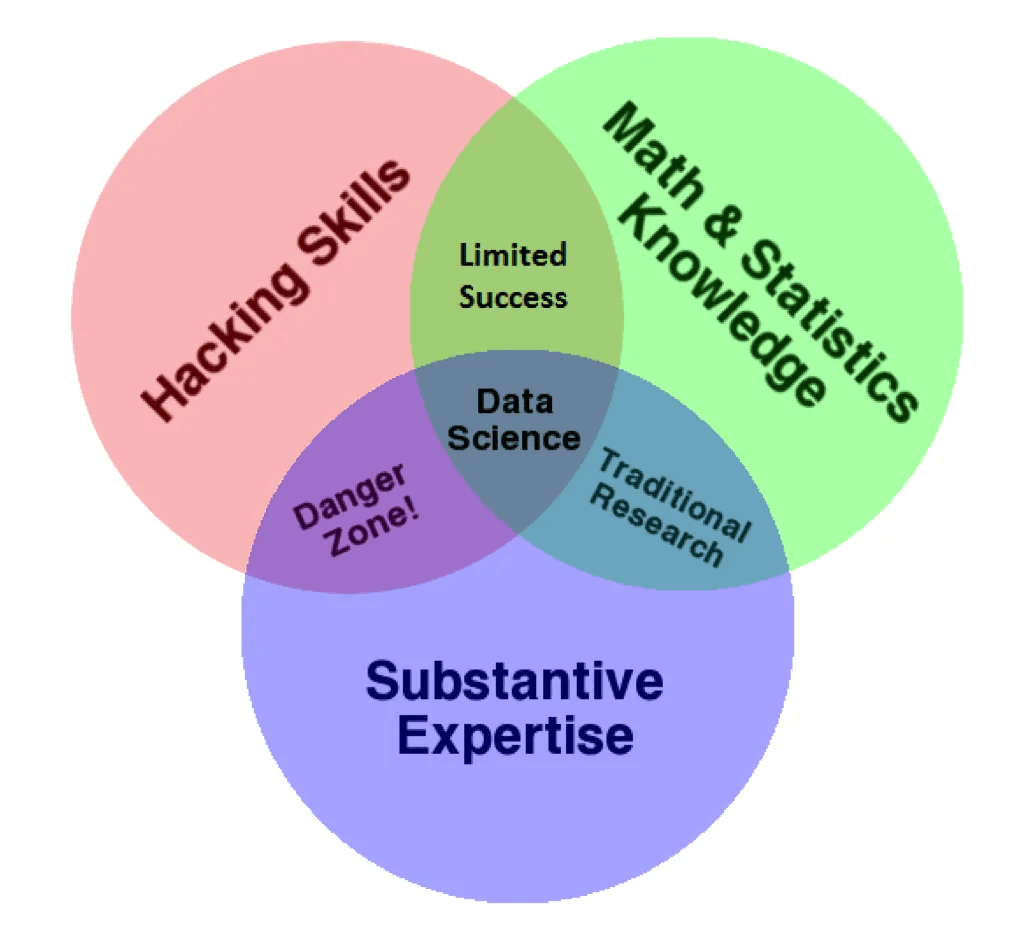
    Skills and Expertise Involved in Data Science
    Skills and Expertise Involved in Data Science

    Without math and statistics knowledge, data science models can be misused, and results can be misinterpreted.

    Data science lifecycle

    There are frequently four phases in a data science lifecycle:

    • Manage: A business problem needs to be improved with insights from data or models. These problems are prioritized and scoped so the data science team can begin work. Models needing refresh or retraining are part of the prioritization process. The team reviews prior work and potential data sources that can be leveraged in the project
    • Develop: Model/ development includes identifying and accessing data, preparing it for use, and the creation of models/analysis to solve the business problem. Data scientists collaborate to create the best model to solve the problem. It may take 100’s of iterations using different tools to find the best solution.
    • Deploy: Validation and testing are necessary prior to deployment/use to ensure the model/analysis performs as expected. Then it is placed into a system or process for use.
    • Monitor: Continuous monitoring of models ensures they perform within expected parameters. If performance decays, they should be refreshed, retrained, or replaced quickly.

    Summary

    • Skills and expertise involved in data science
    • Data science lifecycle