Home
Contact us
Watch Demo
Contact us
Watch Demo
  • Agentic AI
  • AI Governance
  • Airflow
  • Anaconda
  • Apache Spark
  • Artificial Intelligence
  • Clustering
  • Dask
  • Data Science
  • Density-based clustering
  • dplyr
  • Factor analysis
  • Feature
  • Feature Engineering
  • Feature Extraction
  • Feature selection
  • Folium
  • GenomicRanges
  • ggmap
  • ggplot
  • GPU
  • Ground Truth
  • Hash table
  • Hyperparameter Tuning
  • Interpretability
  • Jupyter Notebook
  • Kubernetes
  • LLMOps
  • Machine Learning
  • Machine Learning Algorithms
  • MLOps
  • Model Drift
  • Model Evaluation
  • Model monitoring
  • Model Selection
  • Model Tuning
  • Overfitting
  • Plotly
  • PySpark
  • PyTorch
  • Responsible AI
  • Shiny (in R)
  • sklearn
  • spaCy
  • SR 26-2
  • Statistical Computing Environment (SCE)
  • TensorFlow
  • Underfitting
  • XGBoost
  • Interpretability

    What is interpretability in machine learning?

    Interpretable machine learning means humans can capture relevant knowledge from a model concerning relationships either contained in data or learned by the model. Machine learning algorithms have historically been “black boxes”, that provided no way to understand their inner processes, and made it difficult to explain resulting insights to regulatory agencies and stakeholders.

    Some models, such as those that use linear regression, are highly transparent and interpretable. But other increasingly popular models, such as ones based on deep learning algorithms, have many “hidden layers,” so interpretability gets more and more difficult.

    Interpretability is about the extent to which a cause and effect can be observed within a system. Or to put it another way, it is the extent to which you are able to predict what is going to happen, given a change in input or algorithmic parameters. It’s being able to understand which inputs are the most predictive (i.e., impact the prediction/output the most), and anticipate how predictions will change with differing inputs.

    Interpretability should not be confused with “explainability.” Explainability is the extent to which the internal mechanics of a machine or deep learning system can be explained in human terms. It’s easy to miss the subtle difference with interpretability, but consider it like this: interpretability is about being able to discern the mechanics without necessarily knowing why. Explainability is being able to quite literally explain what is happening.

    Not all machine learning systems require interpretability. Interpretability is not required when there are no significant consequences for unacceptable results, or when the machine learning is validated and trusted in real applications. Interpretability is needed when these conditions are not met, and questions about bias, trust, safety, ethics, and mismatched objectives arise.

    Policing (and interpretability) in the future
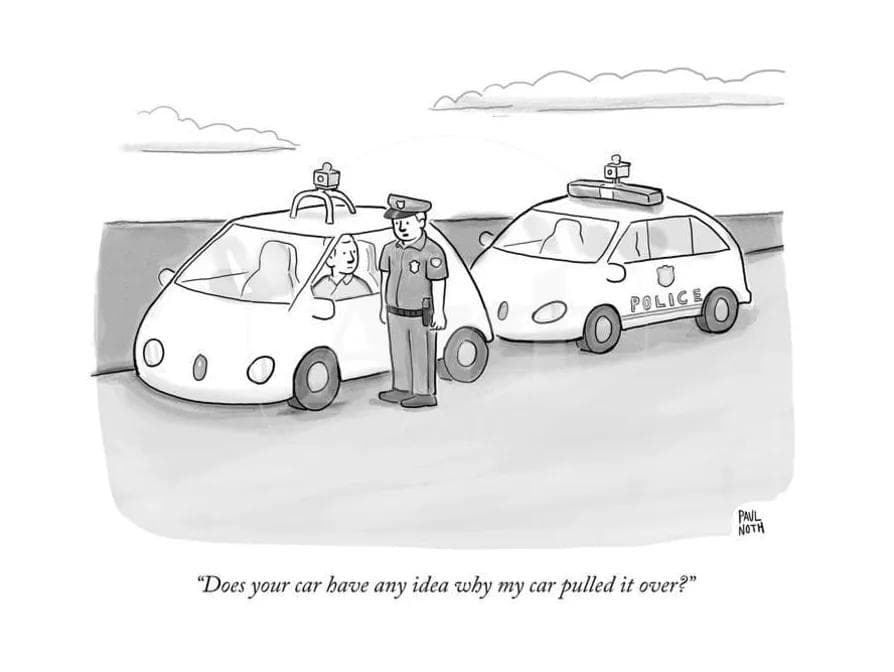
    Example of interpretation of machines using a police officer pulling over a car
    Example of interpretation of machines using a police officer pulling over a car

    Source: Paul Noth

    Summary

    • Policing (and interpretability) in the future
    Domino's logo

    Who is Domino?

    Domino Data Lab empowers the largest AI-driven enterprises to build and operate AI at scale. Domino’s Enterprise AI Platform provides an integrated experience encompassing model development, MLOps, collaboration, and governance. With Domino, global enterprises can develop better medicines, grow more productive crops, develop more competitive products, and more. Founded in 2013, Domino is backed by Sequoia Capital, Coatue Management, NVIDIA, Snowflake, and other leading investors.

    Watch Demo
    • Platform

        • AI infrastructure
        • Data management
        • AI workbench
        • MLOps
        • AI governance
        • FinOps
        • Pricing
        • Security & compliance
        • What's new
    • Solutions

      • Industries

        • Life sciences
        • Finance
        • Public sector
        • Retail
        • Manufacturing
      • Use Cases

        • Generative AI
        • Cost-effective data science
        • Self-service data science
        • Model risk management
        • Cloud data science
    • Learn

        • Events
        • Blog
        • Podcast
        • Courses and certifications
        • Data Science Dictionary
        • Documentation
        • Support
        • Demo hub
    • Company

        • About
        • Why Domino
        • Careers
        • News and press
        • Partners
        • Customers
        • Contact us

    © 2026 Domino Data Lab, Inc. Made in San Francisco.

    • Do not sell my personal information
    • Privacy policy
    • Terms and conditions
    • Security
    • Legal